 PennySleeve
Free with this month's issue: CoroCoro's Pokémon cards
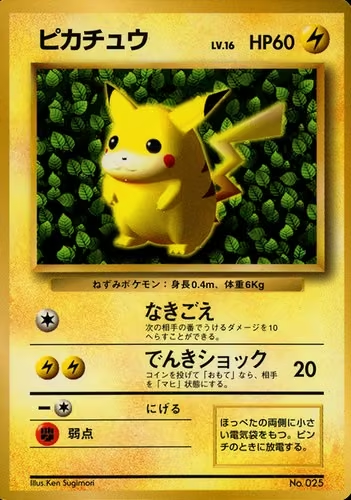
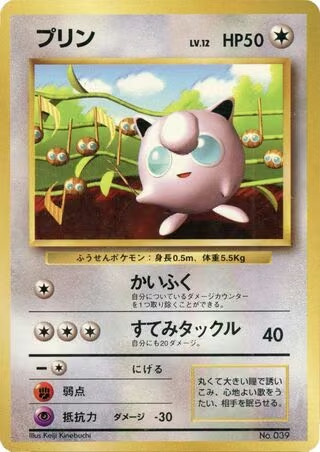
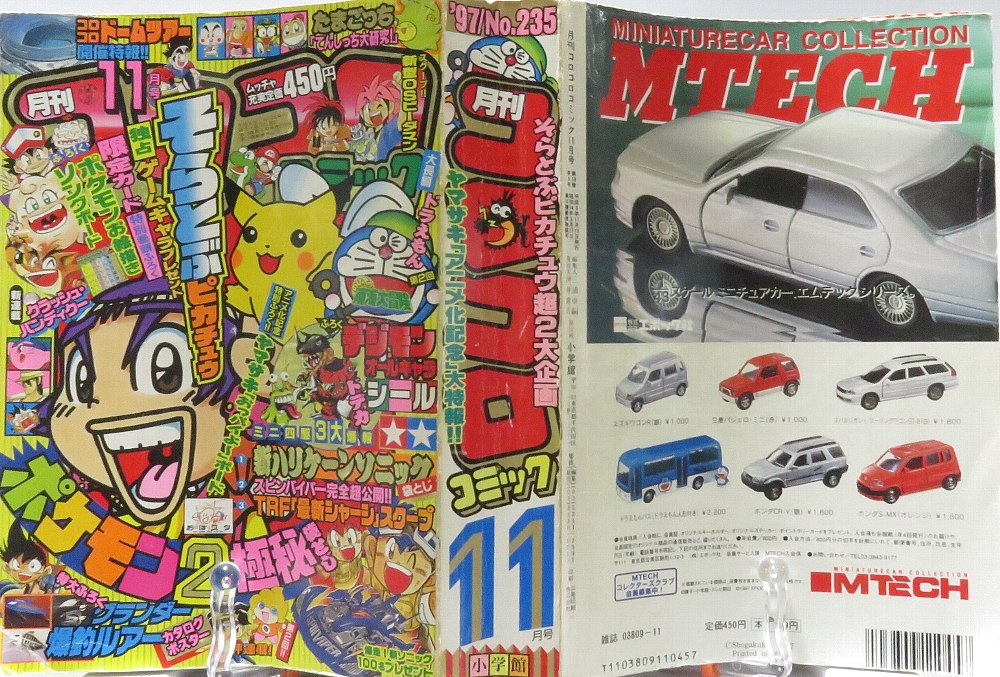
On 15 October 1996, children who bought the November issue of CoroCoro Comic found two glossy cards inside: a Pikachu in front of a wall of ivy leaves, and a Jigglypuff. The Pokémon Card Game itself was still five days from the shops. The Pikachu even named the wrong artist: it credits Ken Sugimori, though Keiji Kinebuchi drew it (CGC). Thirty years later the magazine is still handing out cards.
This story is also told as a magazine-style feature.
Why a comic magazine
Shogakukan launched CoroCoro Comic in 1977 as a home for Doraemon. It comes out monthly, on the 15th, and an issue runs to about 750 pages (Wikipedia). Each issue carries the next month's name, so that first card came with the November issue in mid-October (Bulbapedia).
The magazine had been running a Pocket Monsters manga since April 1996 (Wikipedia), and it was where Pokémon news broke (Bulbapedia). In April 1996 it ran the "Legendary Pokémon Offer": twenty winners could send in their game cartridge to have Mew added. More than 78,000 entries arrived, against the three thousand Nintendo expected, and Satoru Iwata later called it "really when things turned round for Pokémon" (Wikipedia). Pocket Monsters Blue was sold at first only through the magazine, by mail order, from that same 15 October 1996 (Wikipedia).
The first Pikachu
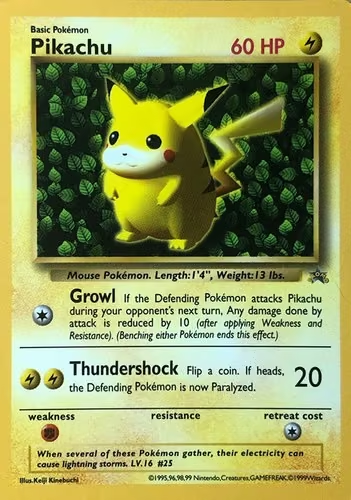
Ivy Pikachu, as collectors call it, has a tangled history. Advertising and the October 1996 issue's cover showed a version with an extra pair of leaves under Pikachu's foot, a "marketing variation" probably never meant to be given out. The card readers actually got had the Sugimori credit. Media Factory's guide "Easily Understand How to Play Pokémon Cards" reprinted it non-glossy, with the right name, in November 1996, and a 1998 CoroCoro prize draw gave a glossy, corrected print to just 2,000 winners. Then, in March 1999, Hyper CoroCoro gave its readers English prints of Pikachu and Jigglypuff with a gray promo star, released only in Japan (CGC). They were printed on Japanese card stock, and both pictures also became English Black Star Promos (Elite Fourum).
A card most months
After that the cards kept coming, most of them now gathered in the CoroCoro Comics set: Mew in January 1997, Mewtwo in May, Surfing Pikachu and Imakuni? in August, Flying Pikachu in October (Bulbapedia). Imakuni? is a photograph, credited "Photo." instead of "Illus.", of the singer who sang and danced the card game's TV commercial song, in his black costume with mouse ears. Its text tells readers to greet him with "Imakuni?-san, konnichiwa" if they meet him in town, and played, it confuses your own Active Pokémon (Pokumon).
In 1998 the Gym Leaders' Pokémon arrived. Brock's Onix and Misty's Staryu came in February, Lt. Surge's Electabuzz and Erika's Dratini in July, and in November a four-card insert of Brock's Mankey, Erika's Bulbasaur, Misty's Tentacool and Lt. Surge's Jolteon, drawn afresh by Ken Sugimori. None of these pictures was printed in English (Elite Fourum).
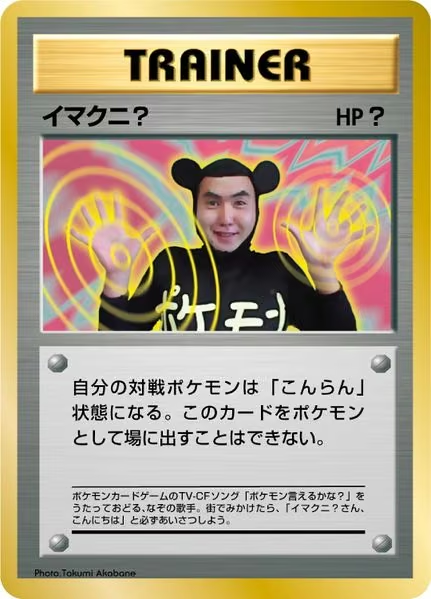
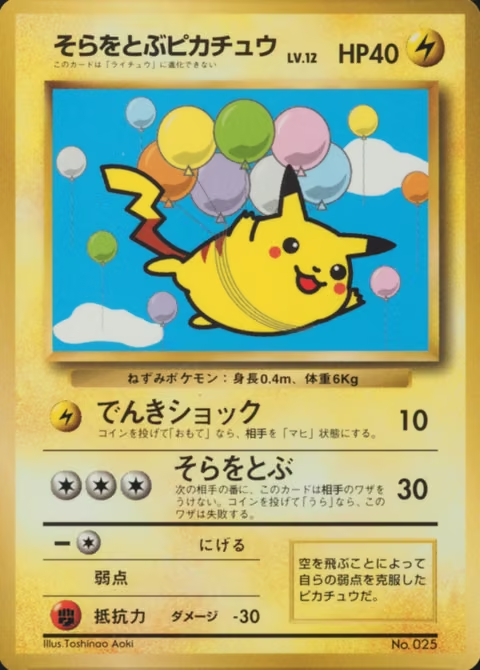
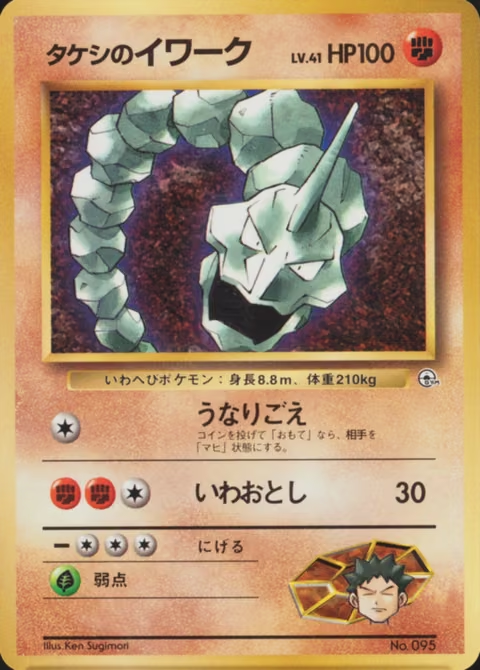
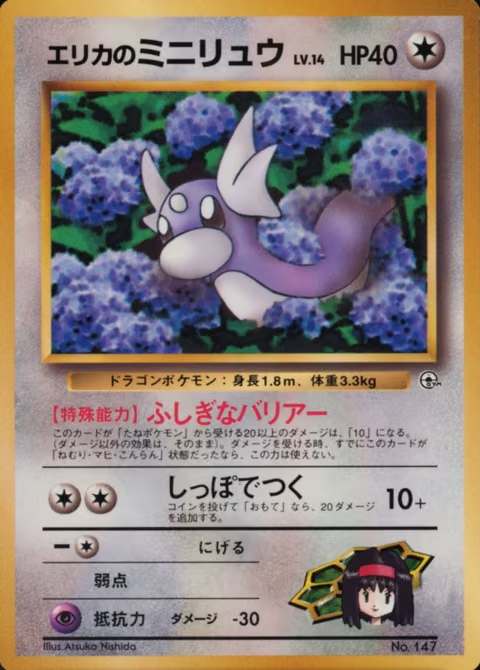
No set symbol of their own
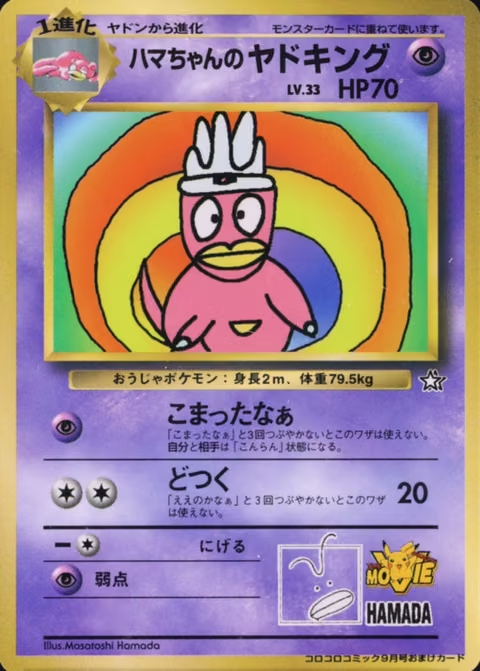
These cards belong to no expansion, and they show it where a set symbol would go. Jynx carries the Poké Ball of the vending machine sheets; the 1998 jumbo cards, such as Pikachu's Summer Vacation, carry CoroCoro's dragon mascot (Elite Fourum); and the promos of the Neo years borrow the symbol of a Neo expansion (Elite Fourum). Some, such as Hama-chan's Slowking in 1999 and Shining Mew in 2001, also print along the bottom edge the issue they came with, in a line such as コロコロコミック11月号おまけカード, "CoroCoro Comic November issue bonus card" (Pokumon, Pokumon).
Readers on the cards
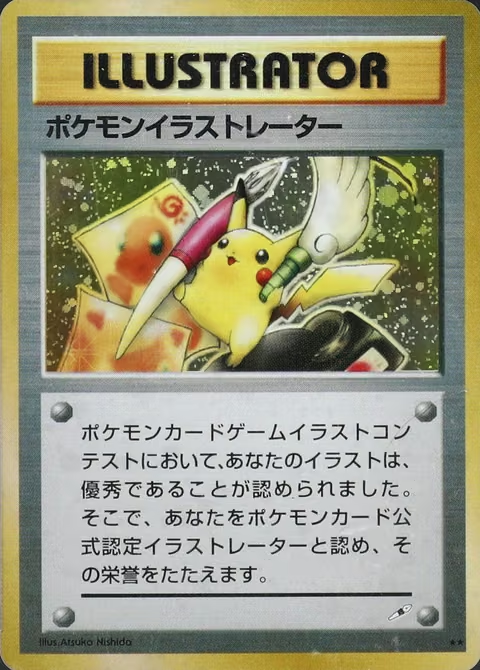
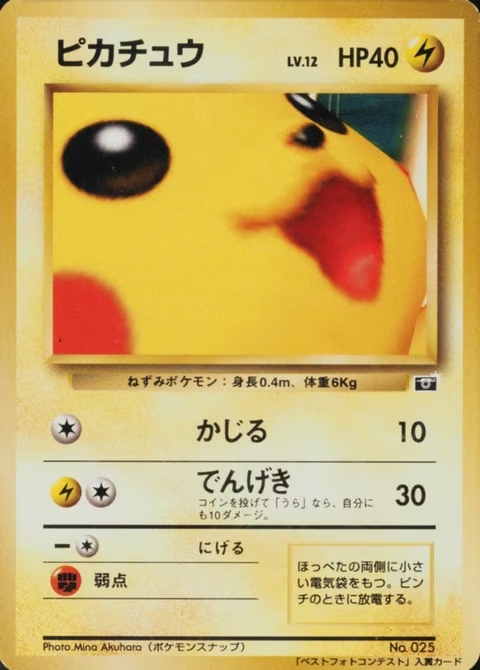
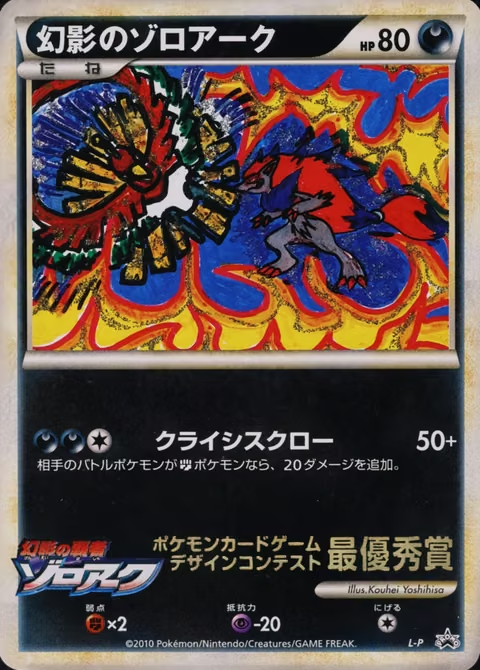
CoroCoro also put its readers on cards. Its first illustration contest, announced in the November 1997 issue, asked for drawings of favorite Pokémon; the 23 winners each got Pokémon Illustrator, a card naming them an officially recognized illustrator. Two more contests in 1998 asked for whole card designs, and 39 copies went out in all (Pokumon). In 1999 readers printed photos from Pokémon Snap as stickers at Lawson shops and posted them in; five photos became cards credited "Photo.", and each winner received 20 copies that November (Pokumon). In 2009 and 2010 CoroCoro and CoroCoro Ichiban! joined Shogakukan's other children's magazines in design contests, whose winning designs were printed as cards, 100 copies each (Pokumon, Pokeboon).
Previews and jokes, 1999 to 2001
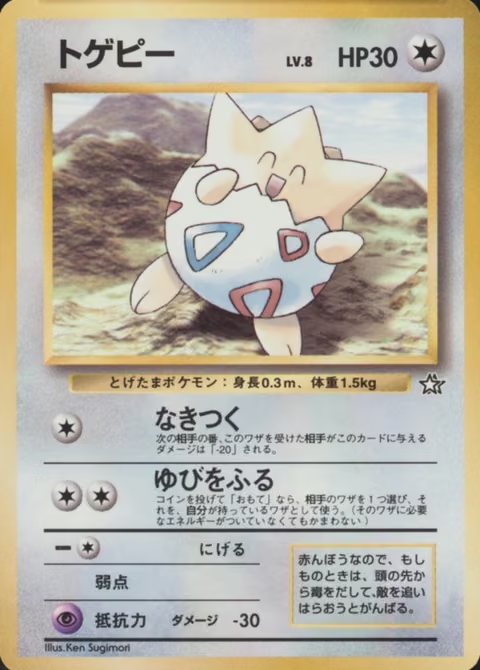
Togepi in May 1999 and Marill in June were Gold and Silver Pokémon on cards, in the old card layout (Elite Fourum), months before the games came out on 21 November 1999 (Wikipedia). In August came Hama-chan's Slowking, for the film Revelation Lugia, in which the comedian Masatoshi Hamada of Downtown voices Slowking (Wikipedia). The card credits its childlike drawing to Hamada, and each attack works only if you first mutter its line three times (Pokumon).
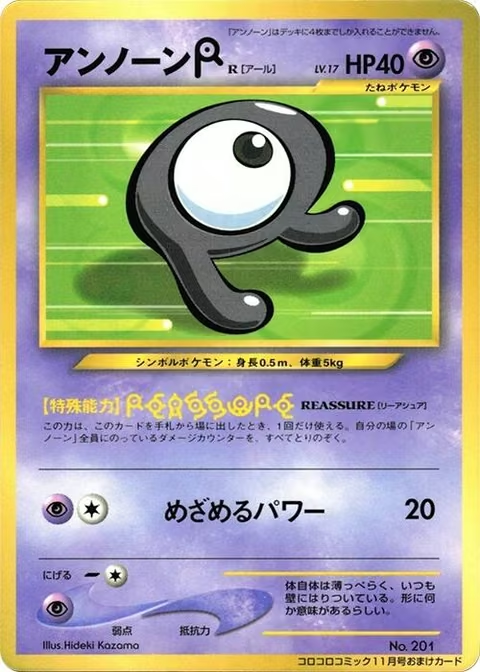
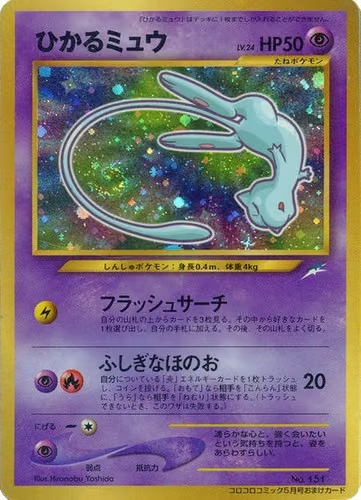
Unown R followed in October 2000, the only R until EX Unseen Forces reprinted the alphabet (Elite Fourum). CoroCoro's last unnumbered card, Shining Mew, came with the May 2001 issue on 15 April 2001 (Bulbapedia), sealed in a packet with Mew on the front (Elite Fourum).
Numbers, tickets and decks
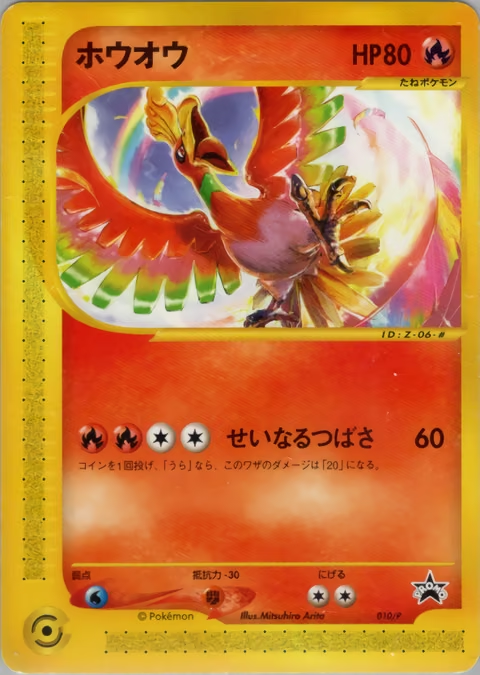
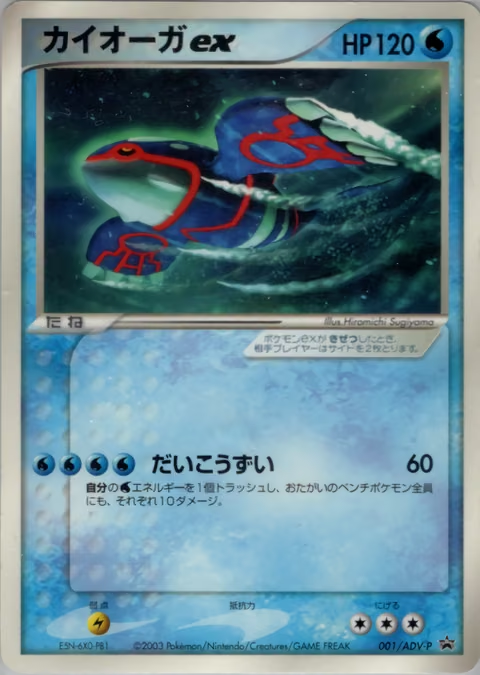
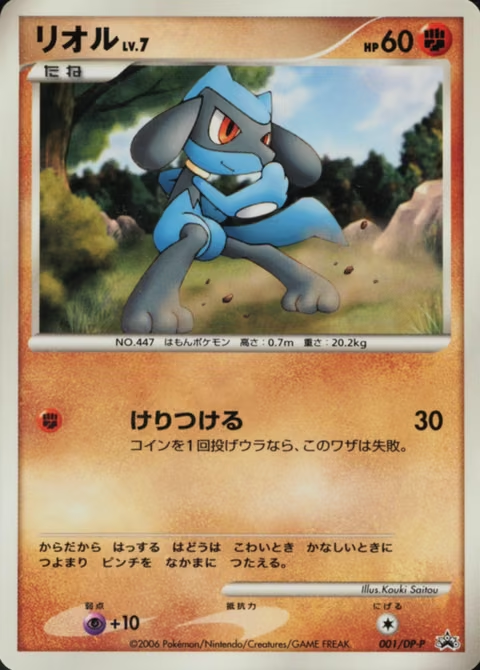
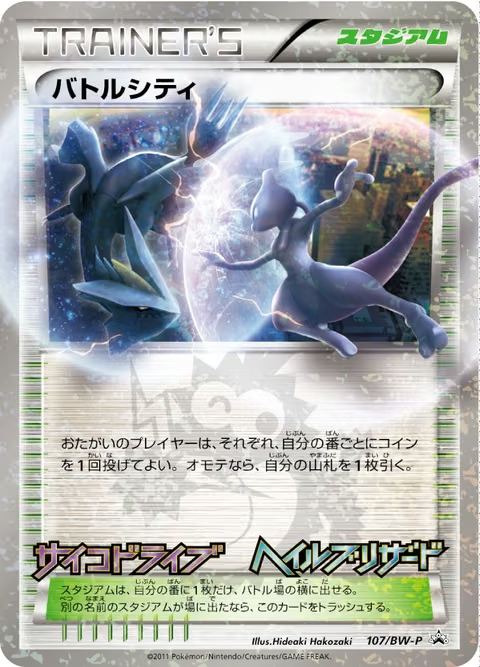
From the August 2001 issue, out that July, CoroCoro's cards carried promo numbers, beginning with Rocket's Sneasel 003/P (Pokumon), and Mitsuhiro Arita's Ho-Oh 010/P came with the December 2001 issue (Pokumon). The giveaways grew more elaborate. The February 2003 issue held Kyogre ex and Groudon ex plus a ticket for a holofoil version at Pokémon Card Gym events (Pokeboon). Riolu came stuck to a mount in the December 2006 issue; taken to an official event, the mount itself, cut out along its perforations, earned a Lucario (Pokeboon). Battle City, from October 2011, has the dragon mascot behind its text (Bulbapedia). The sister magazine CoroCoro Ichiban! has given away dozens more, from Ho-Oh ex with its second issue in 2005 (Pokumon) to Team Rocket's Meowth in 2025 (Pokumon).
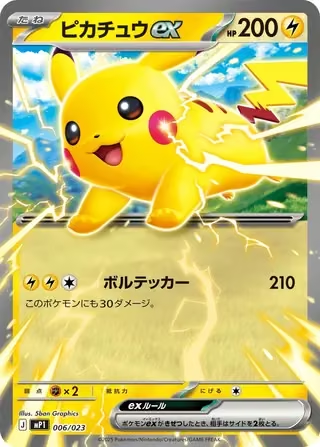
Then came whole decks. The January 2017 issue held a 60-card Rockruff Full Power Deck with Lycanroc-GX (Pokémon Card Game). The February 2022 issue came with Pikachu VMAX 265/S-P (Pokumon) and a code for Start Deck 100 CoroCoro Comic Version: deck number 000, sixty holo cards built around Pikachu and Eevee, the pair that topped the magazine's King of Combi dream-deck poll, sold to up to 100,000 readers (Pokémon Card Game). And on 19 December 2025 the first issue of CoroCiao, a new magazine from CoroCoro and the girls' magazine Ciao, came with a deck holding a newly drawn Pikachu ex found nowhere else (Dengeki Online).
What collectors look for
The early cards came stuck to a board in the magazine, to be peeled off, and a few later ones were sealed in packets. Collectors hunt for copies still unpeeled or unopened; shown a sealed CoroCoro packet, one forum member was not sure they could ever open it (Elite Fourum). Packaging matters most for the late-1998 prize draws, when CoroCoro reprinted 18 cards, most of them its own, for four rounds of 2,000 winners each. Apart from the Pikachu with its corrected credit, those reprints are hard to tell from the originals once they are out of their packaging (Elite Fourum). And when an issue date is quoted, remember it is a month ahead of the day the card reached children's hands.
Thirty years of glue
That hunt for unpeeled copies found its most public collector in 2026. Logan Paul, the YouTuber and wrestler, set out to own an Ivy Pikachu graded Gem Mint 10 by PSA. More than 1,400 glossy copies had been graded without one verified 10; the few 10s once listed for it were traced to mislabeled non-glossy copies (TCG Drop Radar). He bought copies of the November 1996 issue, CoroCoro Comic No. 223, and "pre-production" sheets of the pair that never went into a magazine, to peel the cards himself (Yahoo, Elite Fourum). His documentary, posted on 23 July 2026 (YouTube), showed the first pair, peeled from a magazine, coming back a PSA 5 Pikachu and a PSA 2 Jigglypuff: thirty years pressed between the pages had left bends too faint to see in a scan (TCG Drop Radar).
On 30 July he peeled an unbound sheet live, on a stream that ran about five hours (YouTube). One corner of Jigglypuff took minutes to come free ("30 years of glue", he said). Pikachu came away clean but a little off-center: "In my heart, I think it's a nine… It's that centering." He handed both cards to PSA the next day (TCG Drop Radar), and on 6 August showed the grades (YouTube): Pikachu 9, Jigglypuff 8 (Elite Fourum). Thirty years after children first peeled it off the page, the magazine's first Pikachu is still waiting for its first perfect copy.
Sources
- Wikipedia: CoroCoro Comic
- Wikipedia: Mew (Pokémon)
- Wikipedia: Pokémon Red, Blue, and Yellow
- Wikipedia: Pokémon Gold and Silver
- Wikipedia (Japanese): 劇場版ポケットモンスター 幻のポケモン ルギア爆誕
- Bulbapedia: CoroCoro
- Bulbapedia: Unnumbered Promotional cards (TCG)/1996-2005
- Bulbapedia: Battle City (BW Promo 39)
- CGC: Ivy Pikachu Variant Guide
- Elite Fourum: Japanese Exclusive Unnumbered Promo Cards (1996 - 2001)
- Elite Fourum: CoroCoro Japanese Promo - Reprinted edition
- Elite Fourum: Japanese CoroCoro Comics Promos 1996-2001
- Elite Fourum: what card is this?
- Elite Fourum: Help tracking down names and cards - Non-Set Neo Gen
- Elite Fourum: Best pokemon rookie card(s)
- Pokumon: Early Pokemon Illustration Contests
- Pokumon: 1999 Pokemon Snap Photo Contests
- Pokumon: 2009 Pokemon Card Game Design Contest
- Pokumon: Imakuni? (CoroCoro 1997)
- Pokumon: Hama-chan's Slowking (CoroCoro 1999)
- Pokumon: Shining Mew (CoroCoro 2001)
- Pokumon: Rocket's Sneasel 003/P
- Pokumon: Ho-Oh 010/P
- Pokumon: Ho-Oh ex 076/PCG-P
- Pokumon: Pikachu VMAX 265/S-P
- Pokumon: Team Rocket's Meowth 259/SV-P
- Pokeboon: 小学館10誌連合 ポケモンカードゲーム デザインコンテスト
- Pokeboon: コロコロ2月号おまけカード「グラードンex」「カイオーガex」のキラバージョンをゲットしよう!
- Pokeboon: 「月刊コロコロコミック12月号」ふろくの台紙を持ってイベントに行こう!
- Pokémon Card Game: イワンコ全力デッキ (Wayback Machine copy)
- Pokémon Card Game: 「スタートデッキ100」にコロコロコミックver.が登場! (Wayback Machine copy)
- Dengeki Online: 『コロちゃお』が12/19発売
- Logan Paul on YouTube: his CoroCoro documentary (23 July 2026)
- Logan Paul on YouTube: the live peel (30 July 2026)
- Logan Paul on YouTube: I Got The Grades Back... (6 August 2026)
- TCG Drop Radar: Logan Paul Peeled the First Pokémon Card: What Happened, and What It Graded
- TCG Drop Radar: What Was the First Pokémon Card Ever? The CoroCoro Pikachu, Explained
- Yahoo: Logan Paul's hunt for a Pokémon card that doesn't exist, explained
- Elite Fourum: Logan Paul & Coro Coros